Construction Cost Calculator
Fill in your plot and building details below to get a free, instant building cost estimator result for Pakistan. All prices are shown in Pakistani Rupees (PKR) and every rate assumption can be customized to match your local market — no sign-up required.
Your Estimated Construction Cost Breakdown
| Item | Estimated Cost (PKR) |
|---|
| Material | Estimated Quantity |
|---|
House Construction Cost in Pakistan (2026): The Complete Guide
Rates reviewed: September 2026 · Covers Lahore, Karachi, Islamabad & 8 other cities
Whether you are budgeting for a 5 Marla house, planning a 10 Marla double-storey home, or pricing out a 1 Kanal turnkey project, understanding how construction cost is actually calculated helps you avoid surprises. This free house construction cost calculator guide explains grey structure vs complete vs turnkey construction, typical building cost per square foot, material quantity and labour costs, and how to plan a realistic budget as a construction cost estimator for your own project — including the cost of building a house in Pakistan per Marla. Tap any section below to read the full explanation.
How House Construction Cost Is Calculated in Pakistan
Covered area, quality level, city, design complexity and construction type are the biggest drivers of your total cost.
House construction cost estimation in Pakistan generally works by multiplying your total covered area (in square feet) by a construction rate per square foot, then adjusting for city, quality standard, design complexity and the scope of work you actually want done. Covered area is not the same as plot size — a 5 Marla plot (1,125 sq ft) built as a double storey home could have roughly 1,900–2,100 sq ft of total covered area once you add both floors and typical coverage ratios allowed by local building bylaws.
A detailed estimate, like the one this house construction cost calculator produces, goes a step further by breaking the rate per square foot into its underlying components: material quantities (cement, steel, bricks, sand, crush) multiplied by current market unit prices, plus a separate labour cost for structure work and finishing work. This "bottom-up" approach is more transparent than a single flat rate because you can see exactly which assumption to change if your local prices differ — for example, if cement is more expensive in your city, you only need to update that one number rather than re-estimating the whole project.
Two houses of the same covered area can have very different costs depending on the number of storeys (which affects foundation and steel requirements), the presence of a basement or boundary wall, an architecturally complex design, the number of bathrooms and kitchens (which affects plumbing, tiling and fixture costs), and of course the quality tier chosen for finishing materials.
Grey Structure vs Complete House vs Turnkey Construction
Grey structure is the shell only; complete house adds finishing; turnkey adds fit-outs so you can move straight in.
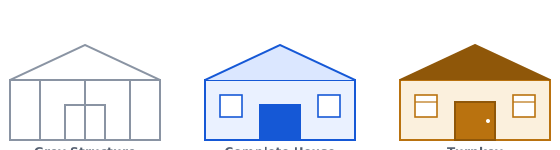
Grey structure cost covers only the structural shell of the house: excavation, foundation, DPC, columns, beams, roof slab, brickwork for walls, and basic staircase. It does not include plaster, flooring, paint, doors, windows, plumbing fixtures, electrical fittings or any finishing work. Many buyers in Pakistan build the grey structure first and finish the house in phases as budget allows — which is exactly why a dedicated grey structure cost calculator is useful on its own.
Complete house construction includes everything in grey structure plus internal and external plaster, flooring and tiling, paint, doors and windows, plumbing pipework and sanitary fixtures, electrical wiring and fittings, and a functional kitchen and bathrooms. This is what most people mean by a "ready to live in, but simply finished" house.
Turnkey construction goes a step further and includes built-in wardrobes, kitchen cabinets, false ceiling where applicable, light fixtures, and other fit-outs — the idea being that you can move in with just your furniture. Turnkey projects cost more per square foot but remove the hassle (and hidden costs) of managing finishing contractors separately.
Typical scope comparison
| Included Work | Grey Structure | Complete House | Turnkey |
|---|---|---|---|
| Foundation, columns, slab, roof | ✔ | ✔ | ✔ |
| Brickwork & DPC | ✔ | ✔ | ✔ |
| Plaster, flooring & paint | ✘ | ✔ | ✔ |
| Plumbing & electrical fittings | ✘ | ✔ | ✔ |
| Boundary wall (optional add-on) | Optional | Optional | Optional |
| Kitchen cabinets & wardrobes | ✘ | Partial | ✔ |
| Move-in ready | ✘ | Mostly | ✔ |
Construction Cost Per Square Foot Explained
Per-sq-ft rates in Pakistan typically range from around PKR 1,800 (grey) to PKR 7,000+ (luxury complete).
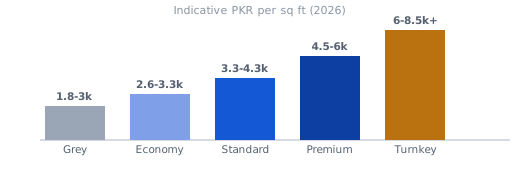
Construction cost per square foot is simply your total estimated cost divided by total covered area, and it's the most common way contractors and homeowners in Pakistan compare projects — and the fastest way to compare a construction cost calculator Lahore result against a construction cost calculator Karachi or construction cost calculator Islamabad result. Based on typical 2026 market data across major cities, indicative ranges are:
- Grey structure only: roughly PKR 1,800 – 3,000 per sq ft
- Complete house — economy quality: roughly PKR 2,600 – 3,300 per sq ft
- Complete house — standard quality: roughly PKR 3,300 – 4,300 per sq ft
- Complete house — premium quality: roughly PKR 4,500 – 6,000 per sq ft
- Turnkey / luxury finishing: roughly PKR 6,000 – 8,500+ per sq ft
These ranges shift with cement, steel and labour prices, and with city — Islamabad and Lahore tend to run slightly higher than smaller cities due to labour and transport costs. Because prices move throughout the year, this construction cost calculator uses editable rate fields so you can plug in your own supplier's current quotation instead of relying on a fixed number.
Material Cost vs Labour Cost: Where Your Money Goes
Materials (cement, steel, bricks, tiles) typically account for 55–65% of total cost, labour for the rest.
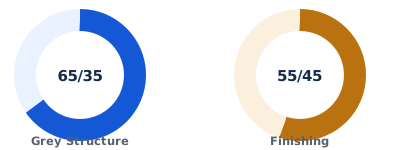
For grey structure work, material cost (cement, steel/saria, bricks, sand and crush) usually makes up 65–75% of the total, with skilled and unskilled labour (mason, steel-fixer, helper) accounting for the rest. For finishing work, the split shifts — tiling, paint, plumbing and electrical fittings are still material-heavy, but skilled labour (tile-layer, electrician, plumber, painter, carpenter) plays a bigger role, often 40–50% of finishing cost.
Common finishing cost categories include: floor and wall tiles, plumbing pipework and fixtures, electrical wiring and switches/sockets, paint and wall finishing, and woodwork such as doors, window frames and, for turnkey projects, cabinets and wardrobes. Each of these is estimated separately in the house construction cost breakdown above so you can see exactly where your budget is going, rather than just one lump "finishing" figure.
5 Marla, 7 Marla, 10 Marla & 1 Kanal House Construction Cost Examples
Illustrative standard-quality, complete-house estimates for the most commonly searched plot sizes.
The table below is generated live by the same calculation engine as the calculator above, using standard quality, complete house construction, in Lahore, with a typical number of storeys for each plot size — a quick reference for anyone comparing a 5 Marla house construction cost against a 10 Marla house construction cost or a 1 Kanal house construction cost in Pakistan. Use the calculator itself for numbers matched to your exact city, quality and design.
Figures update automatically and reflect the default material and labour rates shown in the "Advanced" section of the calculator.
Factors That Affect House Construction Cost
Design complexity, structural spans, site access and material brand choices can shift cost by 20% or more.
- Design complexity: curved walls, large cantilevers, double-height spaces and irregular layouts increase both material and labour cost — use the "Design Complexity" selector above to see the difference.
- Number of storeys and basement: additional floors require stronger foundations, more steel, and add scaffolding and vertical transport costs. Basements add excavation, shoring and waterproofing costs.
- Boundary wall and site works: a boundary wall, gate and external paving are easy to forget when budgeting but can add a meaningful amount to your total project cost.
- Site access and soil conditions: a narrow street or poor soil bearing capacity can increase foundation and labour costs.
- Material brand and quality: branded cement, tested-grade steel and premium tiles/sanitary ware cost noticeably more than generic alternatives.
- City and location: labour rates, transport distance from suppliers, and local demand all shift the rate per square foot.
- Number of bathrooms and kitchens: each additional bathroom or kitchen adds plumbing points, tiling, waterproofing and fixtures.
- Government approval / NOC fees: map approval and building-plan fees vary by development authority and society, and are often overlooked in early budgets.
- Market timing: cement and steel prices in Pakistan can move noticeably within a single year, which is why editable rate fields matter more than a fixed number.
- Contractor type: a labour-only contractor, a material-supply contractor, and a full turnkey contractor all price and mark up differently.
How to Reduce House Construction Cost Without Compromising Quality
Good planning, bulk buying and a simpler design usually save more than cutting corners on materials.
- Finalize your drawings and Bill of Quantities before starting. Mid-construction design changes are one of the most common causes of budget overruns.
- Keep the structural layout simple and efficient. Fewer cantilevers, curves and unusual spans mean less steel and formwork labour — an "Efficient" design in the calculator above can be several percent cheaper than a complex one at the same quality tier.
- Buy major materials (cement, steel) directly where possible instead of through a contractor markup, and buy in bulk when prices are favorable.
- Get at least three itemized quotations from different contractors so you can compare like-for-like scope, not just a single headline number.
- Phase your finishing work — complete the grey structure and essential finishing first, and upgrade fittings, tiles or wardrobes later as budget allows.
- Choose standard sizes for tiles, doors and windows to reduce cutting waste and custom fabrication charges.
- Budget for boundary wall and approval fees up front. These "hidden cost heads" are easy to forget and can strain a budget that only accounted for the house itself.
- Supervise or hire a supervisor. Material pilferage and rework due to poor supervision can add several percent to total cost.
- Avoid over-specifying structural elements. A licensed structural engineer can right-size your foundation, beams and steel instead of blanket over-design.
Frequently Asked Questions
Quick, direct answers about house construction cost, material quantities and this calculator — separate from the full guide above so you can jump straight to the answer you need.
How much does it cost to build a house in Pakistan in 2026?
Most complete (structure plus finishing) houses in Pakistan's major cities cost roughly PKR 3,000 to PKR 5,500 per square foot in 2026, depending on city, quality level and design. A grey-structure-only build typically costs PKR 1,800 to PKR 3,000 per square foot. The exact figure depends on plot size, number of storeys, finishing standard and current material rates, which is why an itemized house construction cost calculator is more reliable than a single flat number.
What is the construction cost per square foot in Pakistan?
Construction cost per square foot in Pakistan usually falls into three broad bands: economy (around PKR 2,600–3,300), standard (around PKR 3,300–4,300) and premium to luxury (PKR 4,500–8,500+), for complete house construction. Grey structure alone is lower, typically PKR 1,800–3,000 per square foot. Rates vary by city, with Islamabad and Lahore generally higher than smaller cities.
What is the difference between grey structure and complete house construction?
Grey structure covers the structural shell only — foundation, columns, beams, slabs, roof and brickwork — without plaster finishing, flooring, paint, doors, sanitary fittings or electrical fixtures. Complete house construction adds all finishing work. Turnkey construction goes further and includes kitchen cabinets, wardrobes, light fixtures and other fit-outs so the house is ready to move into.
How much does a 5 Marla house cost to construct?
A 5 Marla (1,125 sq ft plot) house with a single storey and around 950 sq ft of covered area typically costs roughly PKR 3 million at economy quality, around PKR 4 million at standard quality, and up to PKR 5.5 million or more at premium quality for complete house construction in 2026. A double-storey 5 Marla house with more covered area will cost proportionately more. Grey structure only would be considerably less. Use the calculator above for a figure based on your exact plot, city and quality preference — completely free and with no sign-up required.
How much does a 10 Marla house cost to construct?
A 10 Marla (2,250 sq ft plot) house built as a double storey, with roughly 3,300–3,400 sq ft of covered area, generally costs between about PKR 11 million (economy quality) and PKR 19 million (premium quality) in 2026, with a standard-quality complete build costing around PKR 14 million. Exact cost depends on city, design and finishing choices.
What is the grey structure cost per square foot in Lahore, Karachi and Islamabad right now?
Grey structure cost per square foot moves with cement, steel and local labour rates, so rather than quote one fixed number for every city, this calculator applies an editable city factor — Islamabad currently runs a little higher than Lahore, with Karachi close to Lahore and smaller cities somewhat lower. Select your city above and use the quick-answer strip or the calculator itself for a current, city-adjusted grey structure cost per square foot and complete house construction cost per square foot.
How many cement bags are needed per square foot of construction?
As a general rule of thumb, residential construction in Pakistan uses approximately 0.35 to 0.50 bags of cement per square foot of covered area for the grey structure, depending on slab thickness, quality specification and structural design. This calculator uses an editable default of about 0.42 bags per square foot at standard quality.
How much steel (saria) is required for a house in Pakistan?
Typical residential RCC construction in Pakistan uses around 3 to 4.5 kg of reinforcement steel (saria) per square foot of covered area, depending on the number of storeys, span sizes and structural design. Larger spans, cantilevers and additional storeys increase steel requirements.
How many bricks are needed per square foot of house construction in Pakistan?
A typical residential structure in Pakistan uses roughly 7 to 9 bricks per square foot of covered area for walls and partitions, depending on wall thickness and design. This calculator uses an editable default of about 8 bricks per square foot, and you can adjust the brick price per 1,000 in the Advanced rates panel to match your local supplier's quotation.
What is the average flooring, electrical, plumbing and paint cost per square foot in Pakistan?
For a standard-quality complete house, flooring/tiles typically account for roughly PKR 400–550 per sq ft, electrical wiring and fittings around PKR 200–280 per sq ft, plumbing pipework and fixtures around PKR 220–320 per sq ft, and paint/wall finishing around PKR 170–230 per sq ft — all scaled up at premium and luxury quality. This calculator itemizes each of these automatically inside your finishing cost breakdown, so you do not need to estimate them separately.
How can I reduce my house construction cost without lowering quality too much?
Common ways to reduce construction cost include finalizing a complete design and Bill of Quantities before starting (to avoid costly mid-construction changes), buying bulk materials like cement and steel directly instead of through a contractor markup, choosing a simpler, more efficient layout with fewer curves and cantilevers, phasing finishing work, and getting at least three itemized quotations before hiring a contractor.
How much does a boundary wall cost per running foot in Pakistan?
A plastered brick boundary wall (roughly 6–7 ft high, with pillars and coping) typically costs about PKR 2,200–2,600 per running foot at economy quality, PKR 2,900–3,500 at standard quality, and PKR 3,800–6,000+ per running foot at premium or luxury finish, depending on design and city. Tick "Include Boundary Wall" in the calculator above for an auto-suggested running length based on your plot size, which you can edit if you know your exact boundary measurements.
What are typical government map or building approval (NOC) fees in Pakistan?
Map/building approval and no-objection-certificate (NOC) fees vary widely depending on the development authority or housing society (for example LDA, CDA, RDA or a private housing scheme) and on plot size and category, so there is no single fixed number. This calculator includes an optional, fully editable per-Marla allowance so you can budget for it — always confirm the exact current fee schedule with your relevant development authority or society before finalizing your budget.
Is there a free construction cost calculator in Pakistan that does not require sign-up?
Yes — this house construction cost calculator is 100% free, requires no sign-up, account or contact details, and runs entirely in your browser. Unlike calculators built primarily to collect leads for a construction company, every rate assumption here is shown and editable, and you can download a full itemized PDF report without providing any personal information.
Is this calculator accurate enough to use for a bank loan or tender document?
This calculator provides a planning-stage estimate based on typical Pakistani market rates and standard material-quantity assumptions, all of which are editable. It is a useful starting point for budgeting, but for bank loan applications, tender documents or contracts, you should get a certified estimate or quotation from a licensed structural engineer or registered contractor, since actual costs vary by site conditions, design and current market rates.
How We Calculate These Estimates
This calculator is maintained by a small team with backgrounds in civil engineering, quantity surveying and construction-cost research. Every default rate — cement, steel, bricks, sand, crush, labour and finishing rates, boundary wall and approval-fee allowances — is built from publicly available Pakistani supplier and marketplace pricing and standard quantity-estimation thumb rules used across the industry, then shown openly in the "Advanced" panel so you can verify or override it with your own local quotation.
We review and update these default rates periodically as material and labour prices move. If you notice a default that looks out of date for your city, please use the editable rate fields as your primary source of truth, or get in touch via our About Us page to flag it.